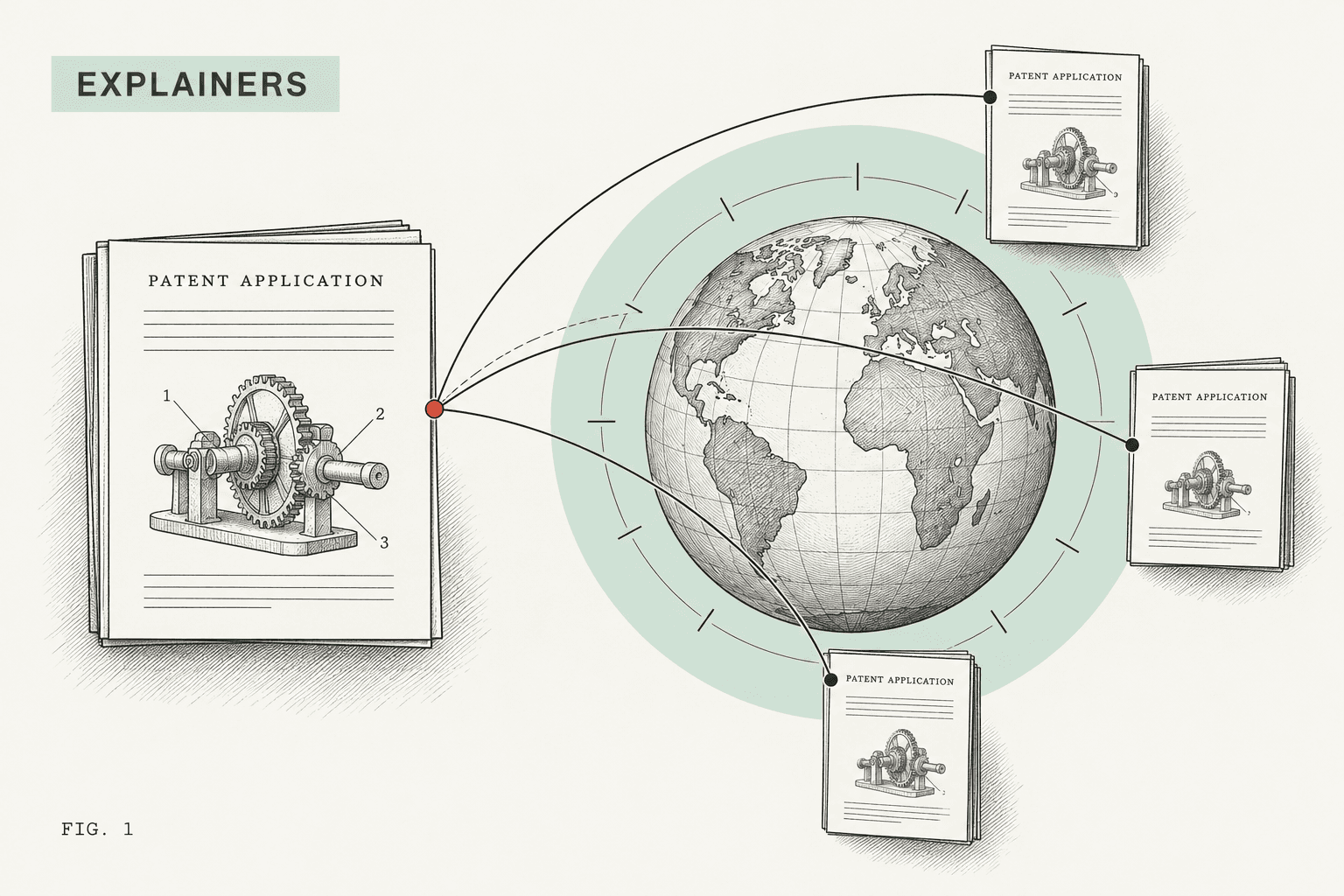
The PCT national phase deadline is the time limit by which an international application must be taken into the national or regional phase before each office where protection is sought. The treaty sets it at 30 months from the priority date, and lets national law allow longer, so the deadline is 30 months at some offices and 31 or more at others. The priority date is the date of the earliest application claimed, covered in the explainer on the priority year. More guides are on the Explainers hub.
What must be done by 30 months?
Three things, office by office. PCT Article 22(1) requires the applicant to “furnish a copy of the international application (unless the communication provided for in Article 20 has already taken place) and a translation thereof (as prescribed), and pay the national fee (if any), to each designated Office not later than at the expiration of 30 months from the priority date.” Offices may require more; the European Patent Office’s list is below.
For counting, Article 2(xi) defines the priority date as the filing date of the application whose priority is claimed, the earliest one where several are claimed, or the international filing date where none is.
Why do some offices allow 31 months?
Because the treaty sets a floor. Article 22(3) provides that “Any national law may, for performing the acts referred to in paragraphs (1) or (2), fix time limits which expire later than the time limit provided for in those paragraphs.” Article 39(1)(b) says the same for elected offices.
What are the deadlines at the major offices?
According to WIPO’s table of time limits, consulted on 30 October 2026, the limit in months from the priority date is the same under Chapter I and Chapter II at these offices. It is 30 at the United States, Japan, Brazil, Mexico and Israel. It is 31 at the European Patent Office, the Republic of Korea, India, Australia, New Zealand, South Africa, the Eurasian Patent Organization and the Russian Federation, and for national filings in the United Kingdom and Germany.
Some offices allow more on conditions. China is listed at 30 months, or 32 if the applicant pays an additional fee for late entry. Canada is listed at 30, with a footnote that reinstatement can be requested up to 12 months after the 30-month deadline on payment of a fee. Singapore’s 30 months “may be extended by up to 18 months” on payment of the prescribed fee, and Bosnia and Herzegovina is listed at 34.
Some states are reached only through a regional office. WIPO’s footnote to the European Patent Office entry says it “acts as the only DO/EO” for Belgium, Cyprus, France, Greece, Ireland, Lithuania, Latvia, Monaco, Montenegro, Malta, the Netherlands, Slovenia and San Marino, so the 31-month EPO limit governs them. WIPO notes that where an office decides to apply longer limits, the information is published in the PCT Newsletter.
Which offices still apply a shorter limit?
Those that notified incompatibility with the 2002 change. An editor’s note to Article 22(1) states that the 30-month limit in force from 1 April 2002 “does not apply in respect of any designated Office which has notified the International Bureau of incompatibility with the national law applied by that Office,” and that the 20-month limit continues for those offices while the incompatibility lasts.
WIPO’s table lists two: Luxembourg, at 20 months under Chapter I, and the United Republic of Tanzania, at 21. Its footnote for both says the office “does not yet apply the 30-month time limit for entering the national phase.” Under Chapter II the table lists Luxembourg at 30 months and Tanzania at 31.
Does demanding Chapter II examination change the deadline?
For most offices in WIPO’s table, no. Article 39(1)(a) applies where a state is elected before the 19th month from the priority date, and sets the same 30 months for elected offices. The table shows a different Chapter II figure for a few offices, including Luxembourg and Tanzania, and lists Uruguay’s Chapter II limit as “Not applicable” because it “has made a declaration under PCT Article 64(1)(a) and is not bound by Chapter II.”
How is a 30-month deadline counted?
By calendar month, to the same day number. PCT Rule 80.2 says a period in months expires “in the relevant subsequent month on the day which has the same number as the day on which the said event occurred,” or on the last day of that month if it has no such day. A priority date of 15 March 2024 therefore gives 15 September 2026 at 30 months, and a priority date of 31 August 2024 gives 28 February 2027.
Under Rule 80.5, where the last day falls on a day the national office is not open for official business, or on certain other listed days, the period expires on the next day to which none of those circumstances applies.
What happens if the deadline is missed?
The application stops having effect there, unless the office keeps it alive. Under Article 24(1)(iii), the effect of the international application “shall cease in any designated State with the same consequences as the withdrawal of any national application in that State” if the Article 22 acts are not performed in time; Article 24(2) lets any designated office “maintain the effect” all the same.
In the United States, 37 CFR § 1.495(h) provides that an international application “becomes abandoned as to the United States thirty months from the priority date” if the requirements of § 1.495(b) are not met; MPEP § 1893.01(a)(1) describes them as paying the basic national fee and making sure a copy of the international application has reached the Office by then. MPEP § 1893.02 points to a petition to revive under 37 CFR § 1.137, covered in the story on the one-year unintentional-delay rule.
At the European Patent Office, Rule 159(1) EPC lists the acts due within 31 months, including any required translation, the filing fee, the designation fee and, where needed, the search fee and the request for examination.
When can rights be reinstated under Rule 49.6?
On request, within a short window. PCT Rule 49.6(a) requires the designated office to reinstate rights “if it finds that any delay in meeting that time limit was unintentional or, at the option of the designated Office, that the failure to meet that time limit occurred in spite of due care required by the circumstances having been taken.” The office chooses which standard applies.
Under Rule 49.6(b), the request must be made and the missed acts performed within whichever expires first: “two months from the date of removal of the cause of the failure” or “12 months from the date of the expiration of the applicable time limit,” unless national law allows a later request. The request must state reasons, and national law may require a fee and supporting evidence.
The rule does not bind every office. Under Rule 49.6(f), paragraphs (a) to (e) do not apply to an office whose law was incompatible with them on 1 October 2002 and which told the International Bureau by 1 January 2003, for as long as the incompatibility lasts. WIPO’s table notes that information on reinstatement and other remedies is in the national chapters of the PCT Applicant’s Guide.
Documents
- WIPO, Time Limits for Entering National/Regional Phase under PCT Chapters I and II
consulted 30 Oct. 2026
- MPEP § 1893, National Stage
§§ 1893.01(a)(1), 1893.02

Staff · Patent decisions, prosecution practice and AI in patent work
Stories under this byline are reported from the primary documents: Federal Circuit opinions, PTAB decisions, USPTO notices and European rulings.
Read more from EditorSpotted an error? Read our editorial standards and corrections policy, or send us a tip.