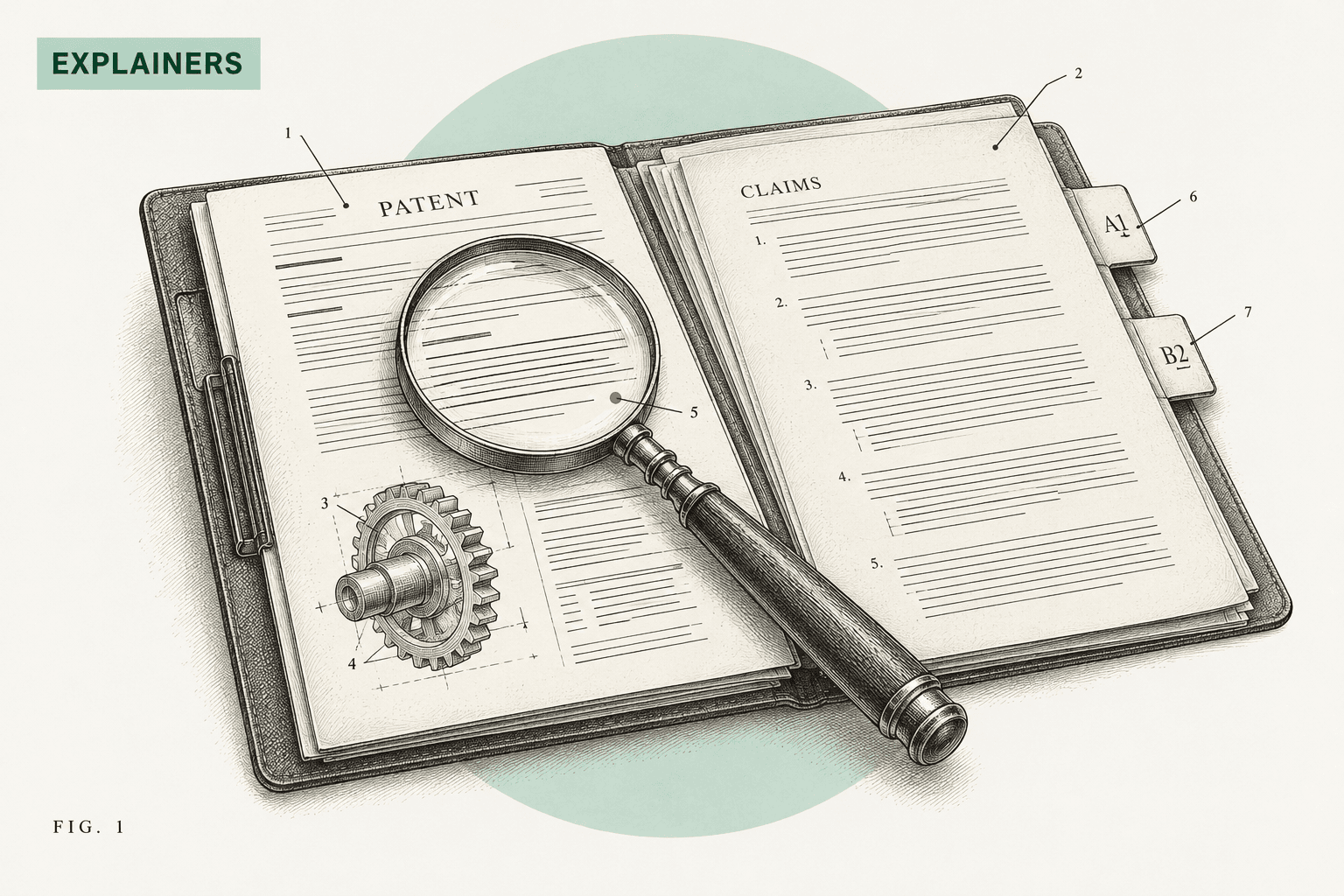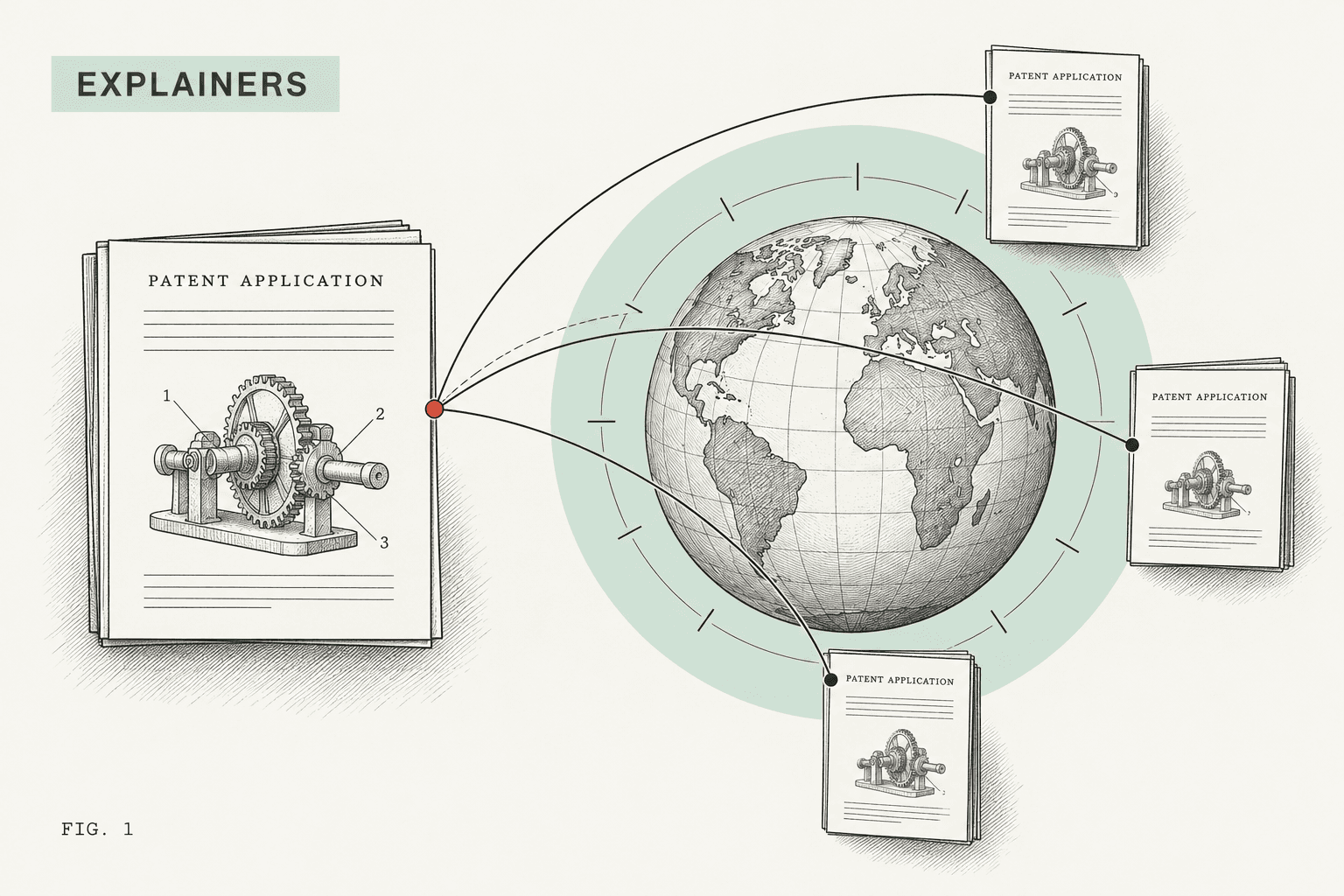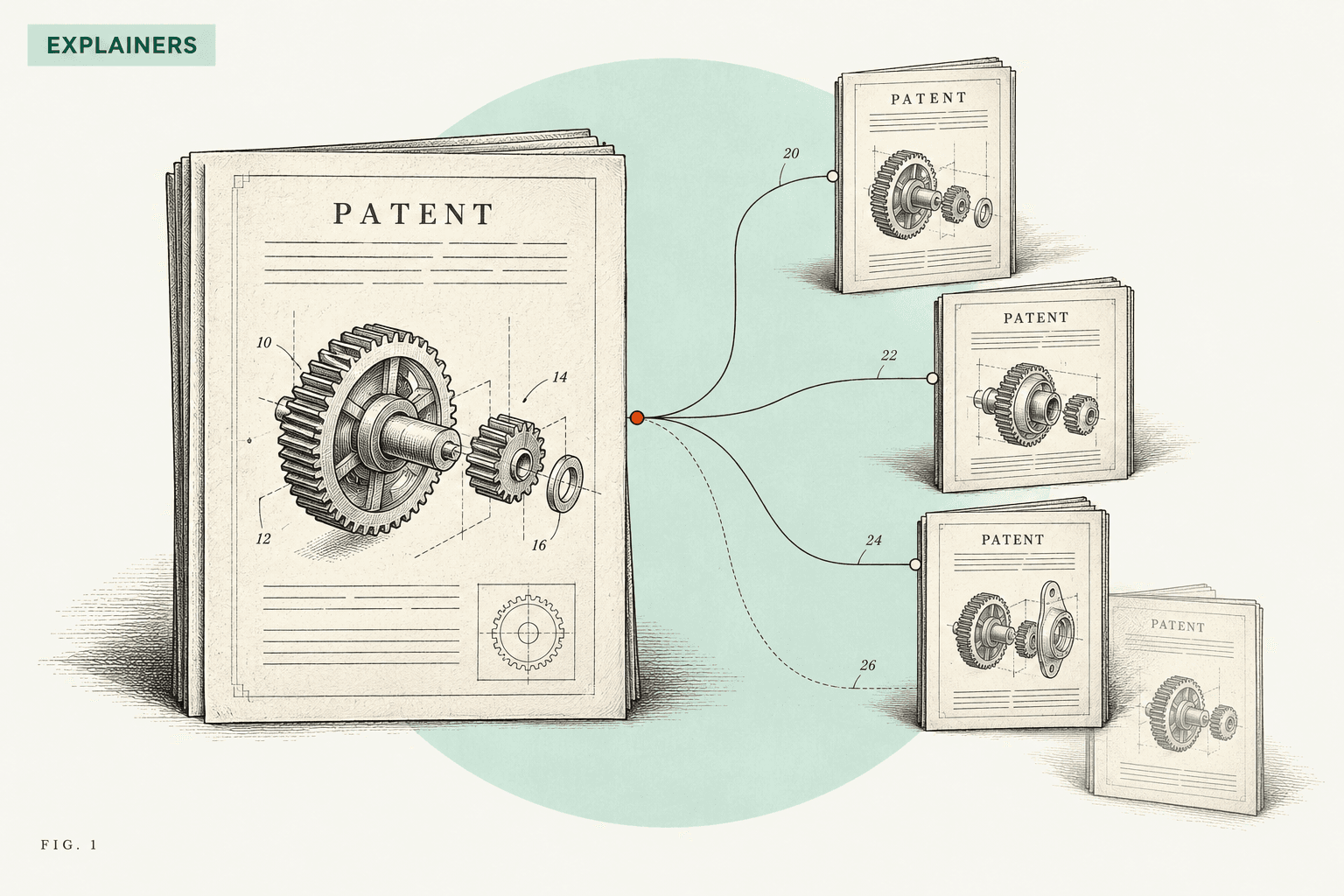
A patent family is a set of patent documents, published in one or more countries or regions, that relate to the same invention or related inventions and are normally linked by the earlier applications whose priority they claim. The glossary in the World Intellectual Property Organization’s Handbook on Industrial Property Information and Documentation defines it as “A collection of published patent documents relating to the same invention, or to several inventions sharing a common aspect, that are published at different times in the same country or published in different countries or regions.” The glossary says its descriptions are “general indications of their main characteristics,” not “exact definitions, in the legal sense.” More guides to the basics are on the Explainers hub.
What holds a family together?
The priority claim. The glossary says each document in a family “is normally based on the data for the application(s) on which the basis for its ‘priority right’ has been claimed.” It calls those earlier filings originating applications, meaning “a national priority application in the sense of the Paris Convention for the Protection of Industrial Property, a regional application or an international application filed under the PCT.” The explainer on the priority year covers how that right works.
What is a simple patent family?
The strictest test. The glossary defines a simple patent family as one “relating to the same invention, each member of which has for the basis of its ‘priority right’ exactly the same originating application or applications.” Its worked example lists ten documents from eight offices (Austria, Switzerland, Germany, Spain, France, Japan, Sweden and the United States), every one based on the same Swiss application, CH 13201/72, which the glossary marks as the first application next to the Swiss member, CH 538767 A.
Two of the offices appear twice in that example: France with FR 2199213 A1 and B1, and Sweden with SE 380138 B and C. In the glossary’s definition a family is a collection of documents, not of countries or granted rights, so the same application published at two stages adds two members. The explainer on reading a patent covers what those letter codes mean.
What is an extended patent family?
A wider grouping. The glossary defines it as a family “relating to one or more inventions, each member of which has for the basis of its ‘priority right’ at least one originating application in common with at least one other member of the family.” Each member needs a link to only one other member, so documents can join through a chain of shared priorities without all claiming the same one.
The glossary’s example has six members. DE 3610333 A1, EP 200874 A1, JP 61-242026 A2 and US 4670093 A all have German application DE 3514301 as a priority basis. The U.S. patent also has a second German application, DE 3610333, as a basis, and EP 240776 A1 and JP 62-232129 A2 have only that second application. The last two share no originating application with DE 3514301, and the U.S. member is what joins them to the rest.
Between the simple and extended types sits the complex patent family: one invention, or several “sharing a common aspect,” where each member has “at least one originating application in common with the other members of the family.”
What are domestic, national and artificial families?
Three narrower or special cases in the same glossary. A domestic patent family consists solely of a single office’s “different procedural publications” for the same originating application or applications, such as an application publication and the later granted patent. A national patent family is published by one office and holds at least two distinct documents that share an originating application through “additions, continuations, continuations-in-part, or divisions.”
An artificial patent family groups equivalent documents from different offices, at least some of which do not share an originating application, or for which data on a shared one is not disclosed. Its members, the glossary says, “are determined only after intellectual investigation to have essentially the same disclosed content.”
What is a triadic patent family?
A measure used in statistics. The OECD describes a triadic patent family as “a set of patents registered in different national patent offices to protect the same invention,” specifically “a set of patents filed at three of these major patent offices: the European Patent Office (EPO), the Japan Patent Office (JPO) and the United States Patent and Trademark Office (USPTO).” It attributes the counts “to the country of residence of the inventor and to the date when the patent was first registered.”
What does a family count measure?
Groups of related filings rather than individual filings. Because a family gathers the documents for an invention, a count of families counts each such group once, however many offices it reaches. WIPO reports its generative AI figures in families: according to its July 2026 update, “Published GenAI patent families rose from around 14,000 in 2023 to over 37,000 in 2025.” The update does not say which family definition the count uses.
Do all databases group families the same way?
No. WIPO’s 2020 PATENTSCOPE help on simple PCT families gives examples. For international application WO2018049420, it says the family “has 12 members while the corresponding EP family has 10 members (RU and IN missing).” For WO2016096779, it says the family “has 20 members in our patent families and 19 in EPO, but the members differ.”
The help document also sets out its own rules. A simple PCT family “contains at least one PCT application as a member,” U.S. provisional applications are ignored only if there is “another genuine first filing,” and “Different republications by the same office are considered one single record containing the latest republication.” Its examples show the same international application with families of different size and membership in different databases.
What does a family not tell a reader?
How many patents were granted. Members include applications and publications at different stages, as the French and Swedish entries in WIPO’s simple-family example show.
That the family is one right. Each patent granted in a family is a separate right in the country or region for which it was granted: under Article 4bis(1) of the Paris Convention, patents applied for in Union countries by nationals of Union countries “shall be independent of patents obtained for the same invention in other countries.”
Which definition a count uses. A simple family, an extended family and a triadic family group documents differently, so a count of one is not a count of another.
Documents
- WIPO Handbook on Industrial Property Information and Documentation, Part 8.1, Glossary of terms
“Patent Family” entry and Appendix III examples, June 2013
- WIPO, The GenAI Landscape Is Getting Bigger And More Competitive According To New WIPO Report
WIPO Patent Analytics, 14 July 2026
- Paris Convention for the Protection of Industrial Property (as amended on September 28, 1979)
WIPO Lex, official translation TRT/PARIS/001; Article 4bis
Staff · Patent decisions, prosecution practice and AI in patent work
Stories under this byline are reported from the primary documents: Federal Circuit opinions, PTAB decisions, USPTO notices and European rulings.
Read more from EditorSpotted an error? Read our editorial standards and corrections policy, or send us a tip.