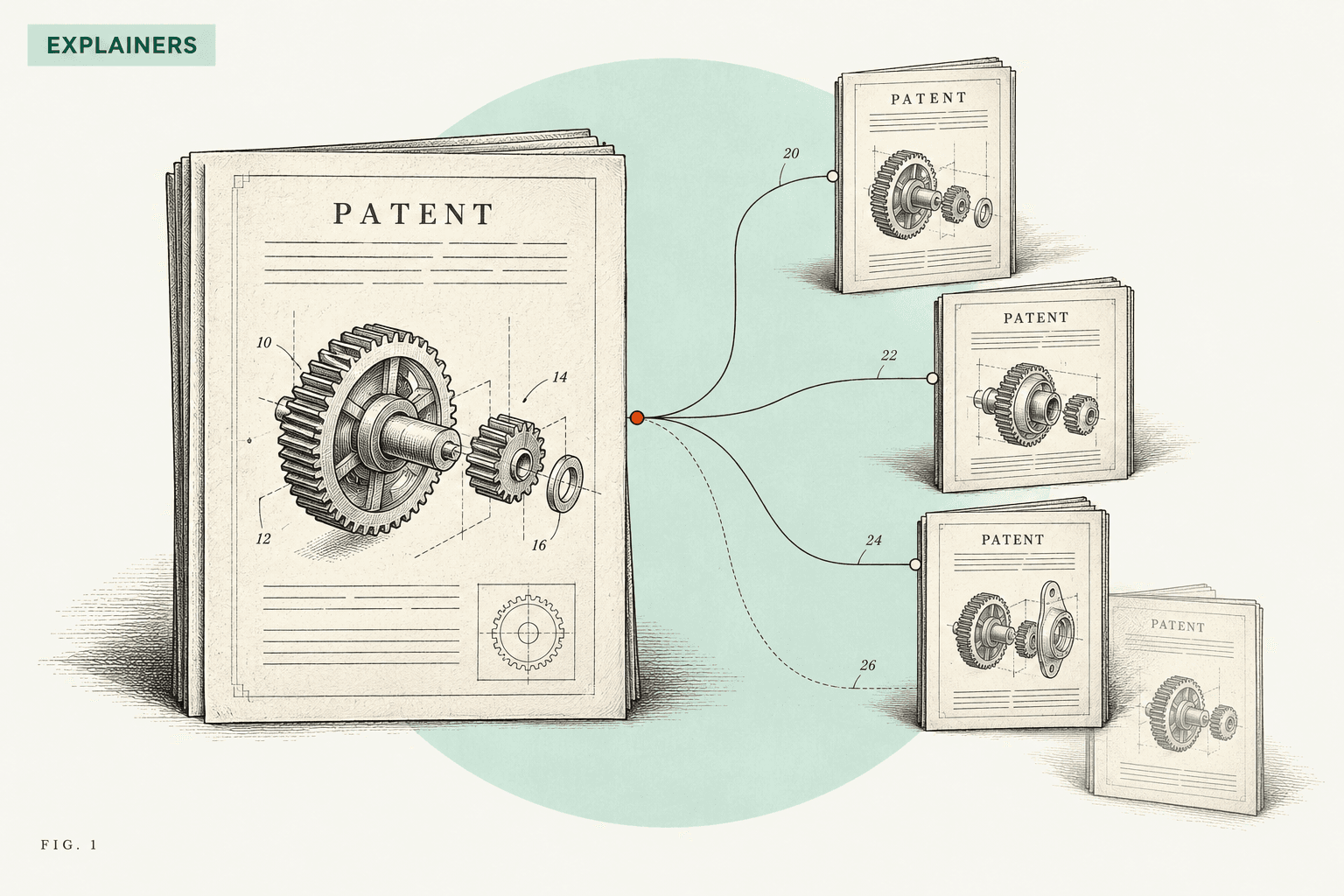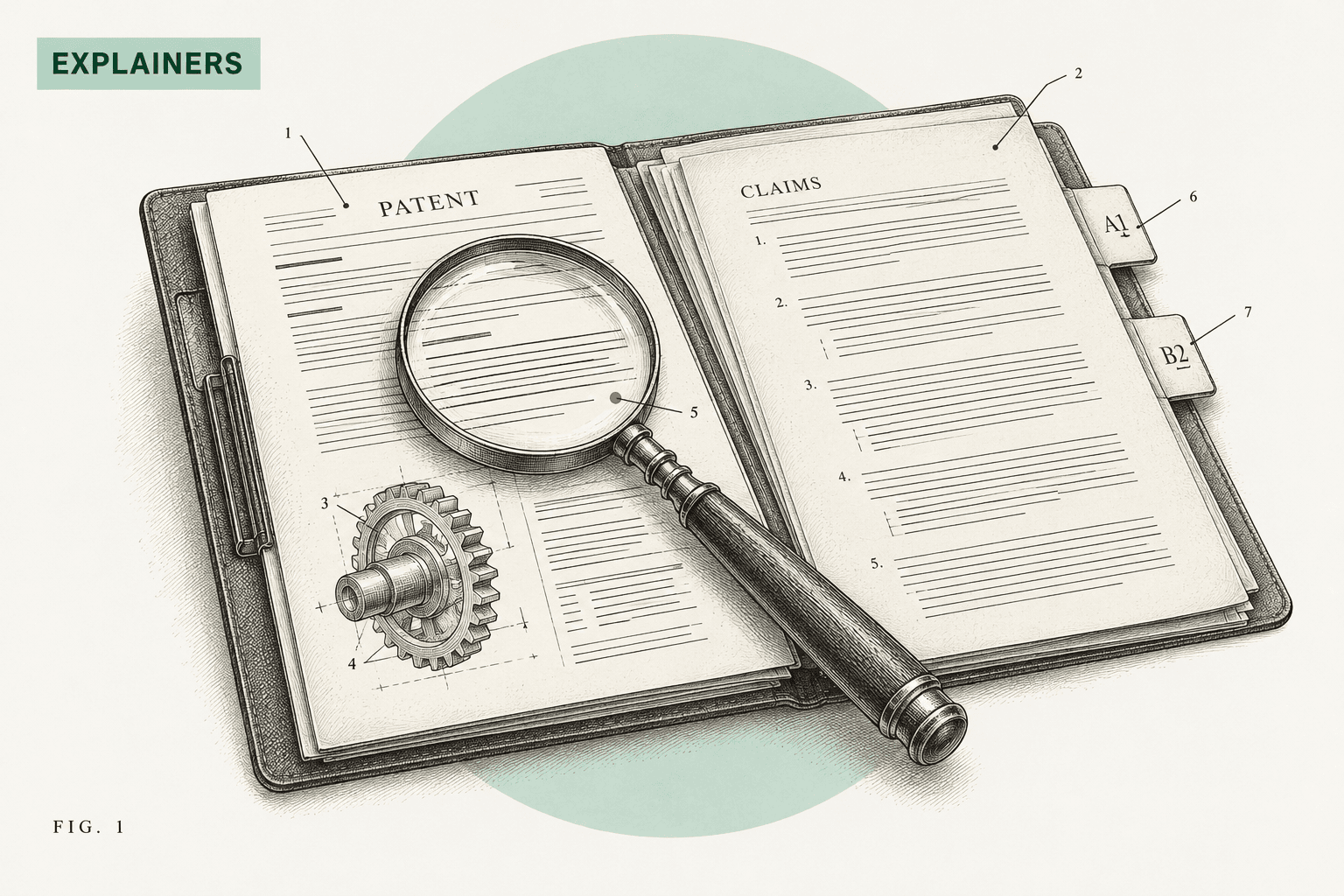
A patent document is the published text of a patent application or a granted patent: a front page of bibliographic data, with the description, the claims and any drawings. Offices that apply the World Intellectual Property Organization’s standards label the front page with the same numbered codes, so the data can be found in any language, and patent law decides which part sets the legal scope. That part is the claims. More guides to the basics are on the Explainers hub.
What are the parts of a patent document?
The treaties list them. Under Article 3(2) of the Patent Cooperation Treaty, an international application “shall contain ... a request, a description, one or more claims, one or more drawings (where required), and an abstract.” Article 78(1) EPC has the same list for a European application. The description must disclose the invention “in a manner sufficiently clear and complete for the invention to be carried out by a person skilled in the art” (PCT Article 5), and in the United States “the specification shall conclude with one or more claims” (35 U.S.C. § 112(b)).
What do the numbers in brackets on the front page mean?
They are INID codes, short for “Internationally agreed Numbers for the Identification of (bibliographic) Data,” defined in WIPO Standard ST.9. The standard lists about 60 data items and gives each a number so that data on a front page “can be identified without knowledge of the language used and the industrial property laws, conventions or treaties applied.” It recommends printing each code immediately before its item, preferably in a small circle or, failing that, in parentheses. ST.9 is a recommendation that offices may adopt; its current revision was approved by the Committee on WIPO Standards on 19 September 2024.
The codes are grouped in tens. Codes in the 10s identify the document: (11) its number, (12) a plain-language name for the kind of document, (13) its kind code and (19) the office that published it. Codes in the 20s describe the application, including (21) the application number and (22) the filing date. Codes (31), (32) and (33) give the number, date and office of any priority application under the Paris Convention or TRIPS; the explainer on the priority year covers what those dates do.
Codes in the 40s give publication dates: (43) for an unexamined document published before any grant, (45) for a document published on or after grant. Codes in the 50s carry technical information: (51) the International Patent Classification, (54) the title, (56) cited prior art and (57) the abstract or a claim.
Codes (62) and (63) identify a parent application for a divisional or a continuation. Codes in the 70s name the parties: (71) the applicant, (72) the inventor, (73) the grantee or owner and (74) the attorney or agent. Codes (86) and (87) give the filing and publication data of a PCT international application.
What does a kind code such as A1 or B2 mean?
It identifies what kind of document it is. WIPO Standard ST.16 provides letter codes “in order to distinguish patent documents published by industrial property offices” and recommends printing them on the first page, after the document number. In its main group, A marks the first publication level, B the second and C the third. Separate letters mark utility models (U, Y and Z), plant patents (P), design patents (S) and translations (T), among others.
A digit after the letter adds detail, and its meaning is set by each office for digits 1 to 7. ST.16 recommends 8 for a corrected front page and 9 for a corrected document. So the letter and digit together have to be read with the office that published the document, using the inventory in Part 7.3.2 of the WIPO Handbook.
What do the common kind codes stand for?
For international applications published by WIPO under the PCT, the Handbook lists A1 as an application published with the international search report, A2 as one published without it, and A3 as the later publication of the search report. For U.S. documents it lists A1 as a patent application publication, used from March 2001; B1 as a patent with no pre-grant publication, from 2 January 2001; and B2 as a patent whose application was published first, from March 2001. For a B1, the Handbook notes that the patent is the first publication, though B is the second level in ST.16. C1, C2 and further C codes have marked reexamination certificates since 2 January 2001, E a reissue patent and S a design patent.
The same letter can mean different things across offices and over time. The Handbook files U.S. utility patents published from 1836 to 2000 under the plain code A, a code not printed on the documents, in a series “Replaced by B1 and B2 patents in 2001,” and lists B1, B2 and later B codes from 29 December 1981 to December 2000 as U.S. reexamination certificates. A1 has marked U.S. published applications since March 2001, and WIPO’s A1 and A2 documents are international applications. Whether a document is a granted patent depends on the office and the date, not on the letter alone.
Which part defines what the patent covers?
The claims. Article 69(1) EPC provides: “The extent of the protection conferred by a European patent or a European patent application shall be determined by the claims. Nevertheless, the description and drawings shall be used to interpret the claims.” PCT Article 6 states that the claims “shall define the matter for which protection is sought,” and Article 84 EPC says the same.
Japan’s Patent Act puts it in similar terms. Article 70(1) provides that the technical scope of a patented invention “must be determined based upon the statements in the claims,” and Article 70(2) that the meaning of terms in the claims is “interpreted in consideration of the statements in the description and drawings.” U.S. law requires claims “particularly pointing out and distinctly claiming the subject matter which the inventor or a joint inventor regards as the invention” (§ 112(b)).
Claims are written in independent or dependent form, and § 112(c) also allows multiple dependent claims. An independent claim stands alone. A dependent claim refers back to another claim and adds a limitation, and under § 112(d) it “shall be construed to incorporate by reference all the limitations of the claim to which it refers.” A dependent claim is therefore narrower than the claim it depends on.
What is the abstract for?
A quick summary, not a statement of scope. Under PCT Article 3(3), the abstract “merely serves the purpose of technical information and cannot be taken into account for any other purpose, particularly not for the purpose of interpreting the scope of the protection sought.” Article 85 EPC is to the same effect, and Article 70(3) of Japan’s Act provides that statements in the abstract “must not be taken into consideration” in determining technical scope. In the United States, 37 CFR § 1.72(b) states that the abstract’s purpose is to let the Office and the public “determine quickly from a cursory inspection the nature and gist of the technical disclosure.”
Where do readers go wrong?
By reading the title or abstract as the scope. The texts above give that role to the claims.
By reading a kind code without its office and date. A WIPO A1 is an international application; a U.S. A1 since 2001 is a published application; and a U.S. B1 or B2 since 2001 is a granted patent, while from 1981 to 2000 the same codes marked reexamination certificates.
By taking the inventor for the owner. ST.9 gives them separate codes: (72) for inventors and (73) for the grantee, holder, assignee or owner, with (71) for the applicant, (75) for inventors who are also applicants and (76) for inventors who are also applicants and grantees.
By reading the filing date (22) as the start of every period. Priority dates appear at (32) and parent applications at (62) or (63), and each can matter for prior art or term; the explainer on patent term shows which dates count toward the 20 years.
Documents
- WIPO Standard ST.9, Recommendation concerning bibliographic data on and relating to patents and SPCs
Revision approved by the Committee on WIPO Standards on 19 September 2024
- WIPO Handbook on Industrial Property Information and Documentation, Part 7.3.2
Inventory of kinds of patent documents by issuing office, November 2022
- Patent Cooperation Treaty, Articles 3, 5 and 6
The international application; description; claims
- European Patent Convention, Articles 78, 84 and 85
Requirements of an application; claims; abstract
- 37 CFR § 1.72, Title and abstract
Electronic Code of Federal Regulations
- Japan Patent Act (Act No. 121 of 1959), Article 70
English translation, Japanese Law Translation database (the Japanese text governs)

Staff · Patent decisions, prosecution practice and AI in patent work
Stories under this byline are reported from the primary documents: Federal Circuit opinions, PTAB decisions, USPTO notices and European rulings.
Read more from EditorSpotted an error? Read our editorial standards and corrections policy, or send us a tip.