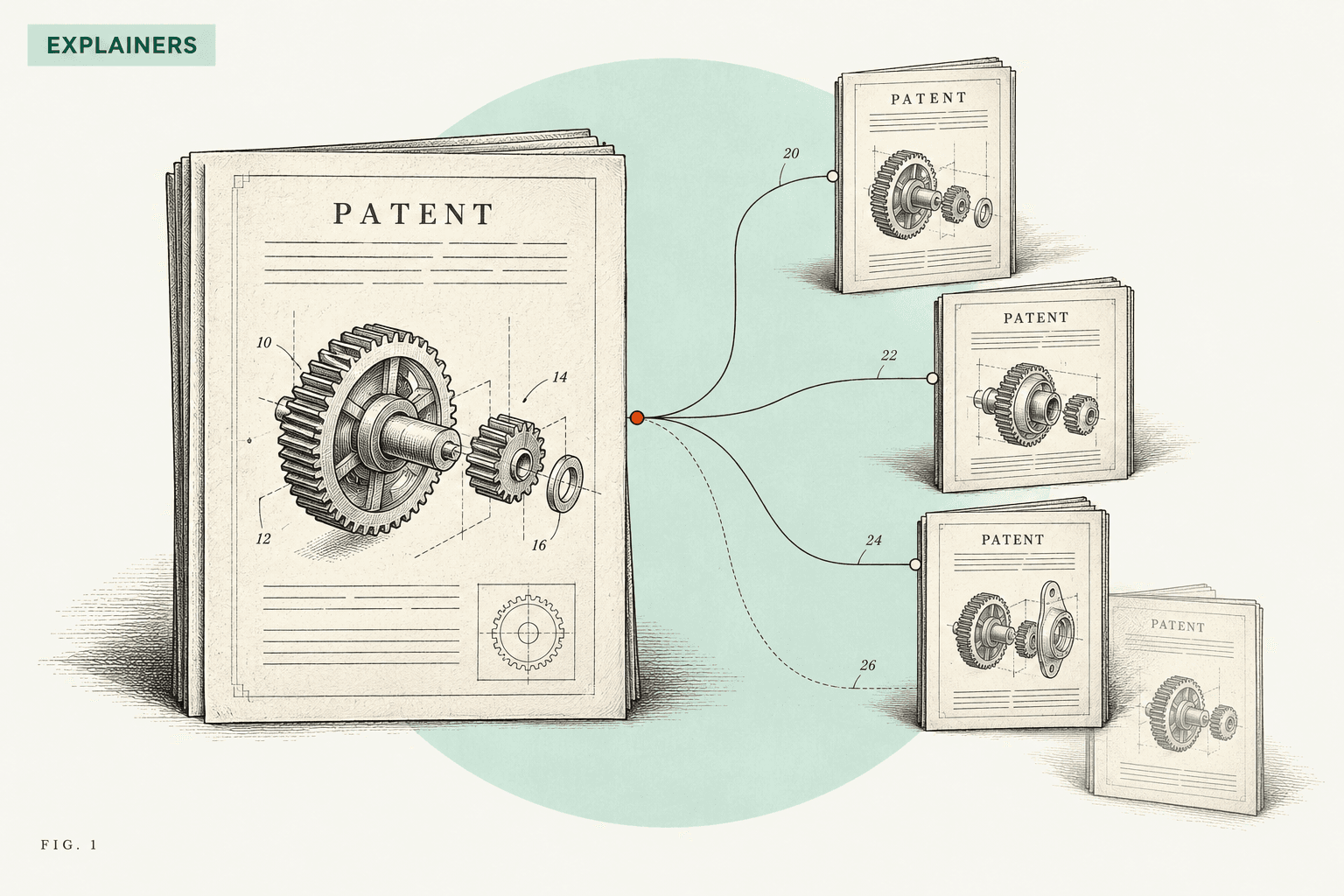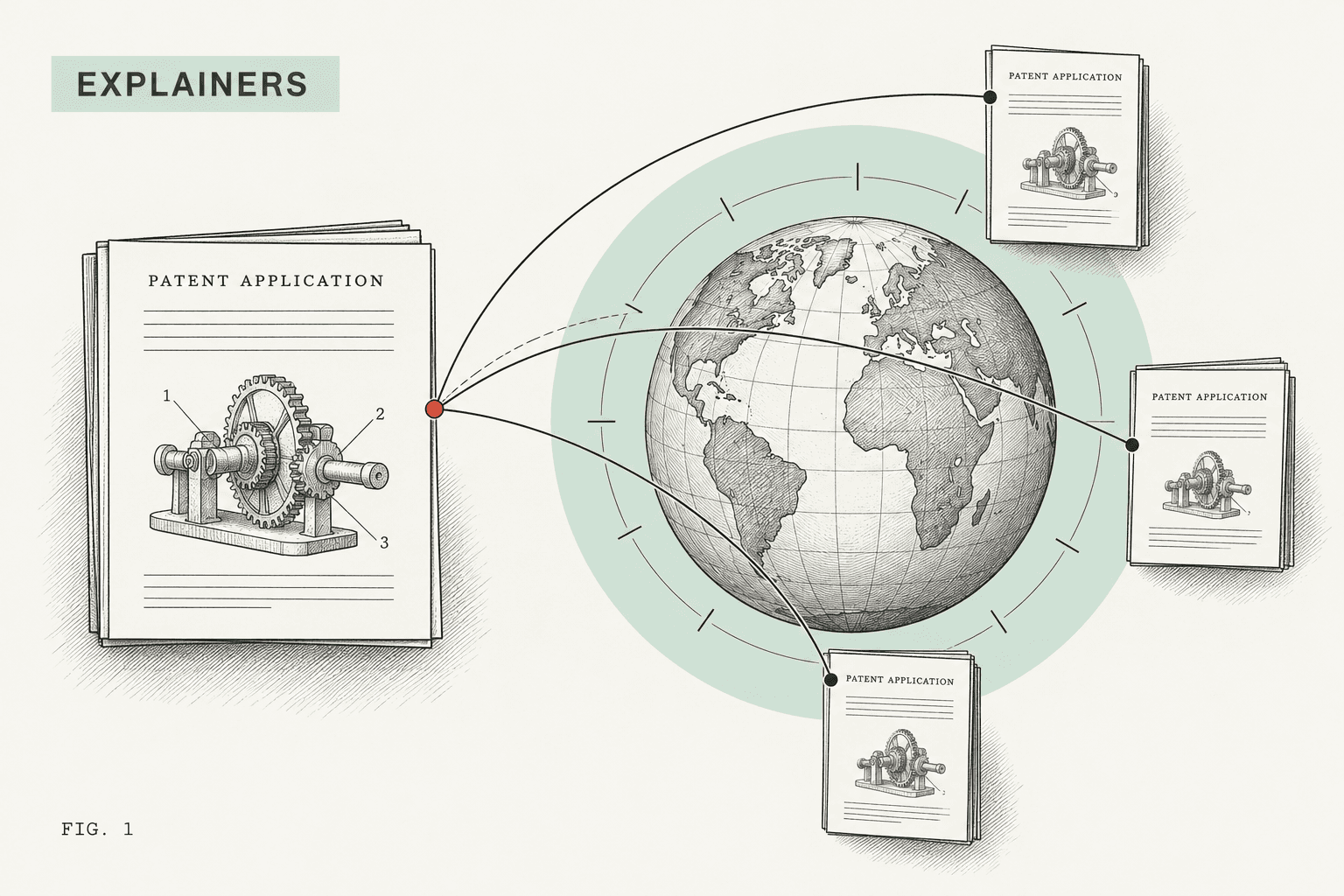
A patent for an invention lasts 20 years from the date its application was filed under the laws of the United States, the European Patent Convention and Japan, and the TRIPS Agreement requires World Trade Organization members to provide at least that. The period is the patent’s term: for a product patent, the time during which its owner can stop others from making, using, offering for sale, selling or importing the product, the rights listed in Article 28(1)(a) of TRIPS. The 20 years are counted from filing, not grant, so time spent in examination comes out of the protected period unless a law gives it back. More guides to the basics are on the Explainers hub.
Where does the 20-year rule come from?
The international minimum is in the TRIPS Agreement, the World Trade Organization’s agreement on intellectual property. Article 33 provides: “The term of protection available shall not end before the expiration of a period of twenty years counted from the filing date.”
The same 20 years appear in national and regional laws. The European Patent Convention provides that “The term of the European patent shall be 20 years from the date of filing of the application” (Article 63(1) EPC). Japan’s Patent Act states that “The term of a patent ends 20 years after the filing date of the patent application” (Article 67(1)). In the United States the rule is in 35 U.S.C. § 154(a)(2).
When does the clock start in the United States?
On the U.S. filing date or, if the application claims an earlier one under §§ 120, 121, 365(c) or 386(c), the earliest such date. Section 154(a)(2) says the term begins when the patent issues and ends “20 years from the date on which the application for the patent was filed in the United States or, if the application contains a specific reference to an earlier filed application” under sections 120, 121, 365(c) or 386(c), “from the date on which the earliest such application was filed.” Sections 120 and 121 cover continuation, continuation-in-part and divisional applications; sections 365(c) and 386(c) cover benefit claims to or from an international patent or design application designating the United States. A continuation filed years after its parent therefore expires 20 years after the filing date of the earliest application it claims under those sections, before any adjustment.
Two earlier dates do not count. Section 154(a)(3) states: “Priority under section 119, 365(a), 365(b), 386(a), or 386(b) shall not be taken into account in determining the term of a patent.” Section 119 covers both priority from an earlier foreign application (§ 119(a)) and the benefit of a U.S. provisional application (§ 119(e)), which requires the non-provisional to be filed within 12 months of the provisional or, under USPTO regulations and on payment of a fee, within two more months if the delay was unintentional. A non-provisional filed 12 months after its provisional, and claiming no earlier § 120 application, therefore expires 20 years after its own filing date, about 21 years after the provisional, before any adjustment.
What happened to the 17-year term?
It survives for older patents. Section 154(c)(1) gives a patent “in force on or that results from an application filed before the date that is 6 months after the date of the enactment of the Uruguay Round Agreements Act” the greater of the 20-year term “or 17 years from grant, subject to any terminal disclaimers.” The Act was enacted on 8 December 1994, so the cut-off date is 8 June 1995.
Can a patent last longer than 20 years?
Yes, in cases the statutes define. U.S. patent term adjustment under § 154(b) adds one day for each day of specified Office delay: no first action or notice of allowance within 14 months of filing; no response to a reply or appeal within 4 months; no action within 4 months after a Board or court decision where allowable claims remain; no patent within 4 months after the issue fee is paid and all outstanding requirements are met; and no patent within 3 years of filing, not counting time taken by requests for continued examination, appeals and certain other proceedings. Delay caused by derivation proceedings, secrecy orders and successful appeals is also added back.
The adjustment is reduced by any period in which the applicant “failed to engage in reasonable efforts to conclude prosecution of the application” (§ 154(b)(2)(C)(i)). For the three-year guarantee, the statute counts as such a failure any time beyond three months taken to respond to an Office notice, and it leaves the rest to USPTO regulations.
A second mechanism, patent term extension under 35 U.S.C. § 156, restores time to a patent on a drug, medical device, food additive or color additive whose product “has been subject to a regulatory review period before its commercial marketing or use.” A patent can receive only one extension under § 156(e)(1), generally where the approval was the product’s first permitted commercial marketing or use under the law that required the review (§ 156(a)(5)). The extension cannot exceed five years for a patent issued after the section was enacted (§ 156(g)(6)); the term remaining after approval plus the extension cannot exceed fourteen years (§ 156(c)(3)); and only one patent can be extended for the same regulatory review period of a product (§ 156(c)(4)).
Other systems have comparable provisions. Article 63(2) EPC leaves each contracting state free to extend the term of a European patent, or to grant “corresponding protection which follows immediately on expiry of the term of the patent,” on the same conditions as for national patents, in a war or similar emergency or where the patent covers a product, a process for making it or a use of it which “has to undergo an administrative authorisation procedure required by law before it can be put on the market in that State.” Japan’s Patent Act allows an extension where the patent was registered on or after the later of five years from filing and three years from the request for examination (Article 67(2)), and an extension of up to five years where a required safety permission kept the owner from working the invention (Article 67(4)).
What can end a patent before 20 years?
Unpaid fees can. Section 154(a)(2) grants the term “subject to the payment of fees,” and 35 U.S.C. § 41(b) sets maintenance fees for U.S. utility patents at 3 years and 6 months, 7 years and 6 months, and 11 years and 6 months after grant. If a fee is not paid by its due date or within a six-month grace period, for which the Office may charge a surcharge, “the patent shall expire as of the end of such grace period.”
The Director may accept a later payment if the delay was unintentional (§ 41(c)(1)). Under § 41(c)(2), a person who made, purchased, offered to sell, used or imported something protected by the patent after the grace period and before the payment was accepted may continue to use, offer for sale or sell “the specific thing so made, purchased, offered for sale, used, or imported,” and a court may allow more on equitable terms. The report on the USPTO’s one-year rule for unintentional-delay petitions covers that petition.
In Europe, renewal fees for a pending application are due to the EPO “in respect of the third year and each subsequent year, calculated from the date of filing,” and if one is not paid in due time “the application shall be deemed to be withdrawn” (Article 86(1) EPC). That obligation ends with the fee for the year in which the mention of the grant is published (Article 86(2)); renewal fees for the granted patent fall under Article 141 EPC for the years that follow.
A term can also be cut short. Under 35 U.S.C. § 253(b), a patentee or applicant “may disclaim or dedicate to the public the entire term, or any terminal part of the term,” and § 154(b)(2)(B) bars any adjustment beyond a disclaimed date. A patent can also be revoked or held invalid, and TRIPS Article 32 requires that judicial review be available for any decision to revoke or forfeit one.
How long do design patents last?
U.S. design patents, which cover a “new, original and ornamental design for an article of manufacture” (35 U.S.C. § 171), are counted from grant instead. Section 173 provides: “Patents for designs shall be granted for the term of 15 years from the date of grant.” According to MPEP § 1505, the 15-year term applies to design applications filed on or after 13 May 2015, and design patents from earlier applications have a 14-year term from grant.
No maintenance fees are due on design or plant patents (§ 41(b)(3)). Plant patents take the utility term of 20 years from filing, because 35 U.S.C. § 161 applies the provisions for patents for inventions to plant patents “except as otherwise provided.”
What does the 20-year rule not mean?
It does not run from grant. Apart from design patents and the older U.S. patents covered by § 154(c), the term runs from filing, so a utility patent that took four years to issue has about 16 years left at grant, before any adjustment.
It does not run from the priority date. Neither a foreign priority application nor a U.S. provisional starts the U.S. clock (§ 154(a)(3)), and Article 63(1) EPC and Article 67(1) of Japan’s Act also count from the filing date.
It does not restart for a continuation or divisional, which ends 20 years after the earliest application it claims under § 120, 121, 365(c) or 386(c) (§ 154(a)(2)).
And it is not the final expiry date. Patent term adjustment and a § 156 extension can lengthen the term; a terminal disclaimer or a missed fee can shorten it. Rule changes at the Office are tracked on the USPTO & Prosecution hub.
Documents
- TRIPS Agreement, Part II, Section 5: Patents (Articles 27 to 34)
WTO legal text; term of protection is Article 33
- 35 U.S.C. § 154, Contents and term of patent; provisional rights
Term, priority exclusion, patent term adjustment, pre-1995 rule
- 35 U.S.C. § 41, Patent fees; patent and trademark search systems
Maintenance fee schedule and grace period, § 41(b) and (c)
- 35 U.S.C. § 119, Benefit of earlier filing date; right of priority
Foreign priority, § 119(a); provisional applications, § 119(e)
- 35 U.S.C. §§ 120, 121, 365 and 386, Benefit of earlier filing dates
Also 35 U.S.C. § 121, § 365 and § 386 on law.cornell.edu
- 35 U.S.C. § 156, Extension of patent term
Regulatory review extension
- 35 U.S.C. § 173, Term of design patent
15 years from grant
- MPEP § 1505, Term of Design Patent
USPTO, R-08.2017; 14 or 15 years depending on filing date
- 35 U.S.C. § 253, Disclaimer
Terminal disclaimers, § 253(b)
- European Patent Convention, Article 63, Term of the European patent
20 years from filing; national extensions, Art. 63(2)
- Japan Patent Act (Act No. 121 of 1959), Article 67
English translation, Japanese Law Translation database (the Japanese text governs)

Staff · Patent decisions, prosecution practice and AI in patent work
Stories under this byline are reported from the primary documents: Federal Circuit opinions, PTAB decisions, USPTO notices and European rulings.
Read more from EditorSpotted an error? Read our editorial standards and corrections policy, or send us a tip.