On 21 October 2026 the Court of Appeal of the Unified Patent Court held in Agfa v. Gucci that a manufacturing method is part of the state of the art under Article 54(2) EPC when a publicly used product lets the skilled person establish the method “without undue burden” by analysing its composition, and that the skilled person needs no “particular reasons” to carry out that analysis. Applying that rule, Panel 1a revoked European Patent 3 388 490 in large part and rejected Agfa’s appeal against the dismissal of its infringement action. The decision sets aside in part the 30 April 2025 decision of the Hamburg Local Division, which had upheld the patent in full, while agreeing with its dismissal of the infringement action.
The panel comprised Klaus Grabinski, President of the Court of Appeal, legally qualified judges Peter Blok, the judge-rapporteur, and Emmanuel Gougé, and technically qualified judges Casper Struve and Carola Wagner. The oral hearing took place on 10 September 2026. The decision consolidates ten appeals: Agfa’s appeal, UPC_CoA_602/2025, and Gucci’s appeals, UPC_CoA_582/2025 and 590/2025 to 597/2025. Coverage of the court’s other decisions is on the Europe hub.
What did the court decide about public prior use?
Two headnotes state the rule. First, a manufacturing method of a publicly used product “is made available to the public by use pursuant to Art. 54(2) EPC if, at the relevant date, the person skilled in the art could establish the method without undue burden by analysing the product’s composition,” and “[t]here is no support in the EPC for an additional requirement that the skilled person would need particular reasons for analysing the product.” Second, where a product discloses information relevant to the novelty of a claimed method, the disclosure must let the skilled person use the claimed method on the basis of common general knowledge, but “[r]eproducibility of features which are not part of the claimed invention is not required.”
Agfa had argued that the skilled person had no reason to test Gucci’s products for photoinitiators, the compounds that reveal a UV-curable ink. The court called that argument “irrelevant” in light of its first headnote. It also rejected Agfa’s point that the Raman report did not reveal pigment quantities: specific quantities were not claimed, so their reproducibility did not matter.
How did Gucci prove what its own products disclosed?
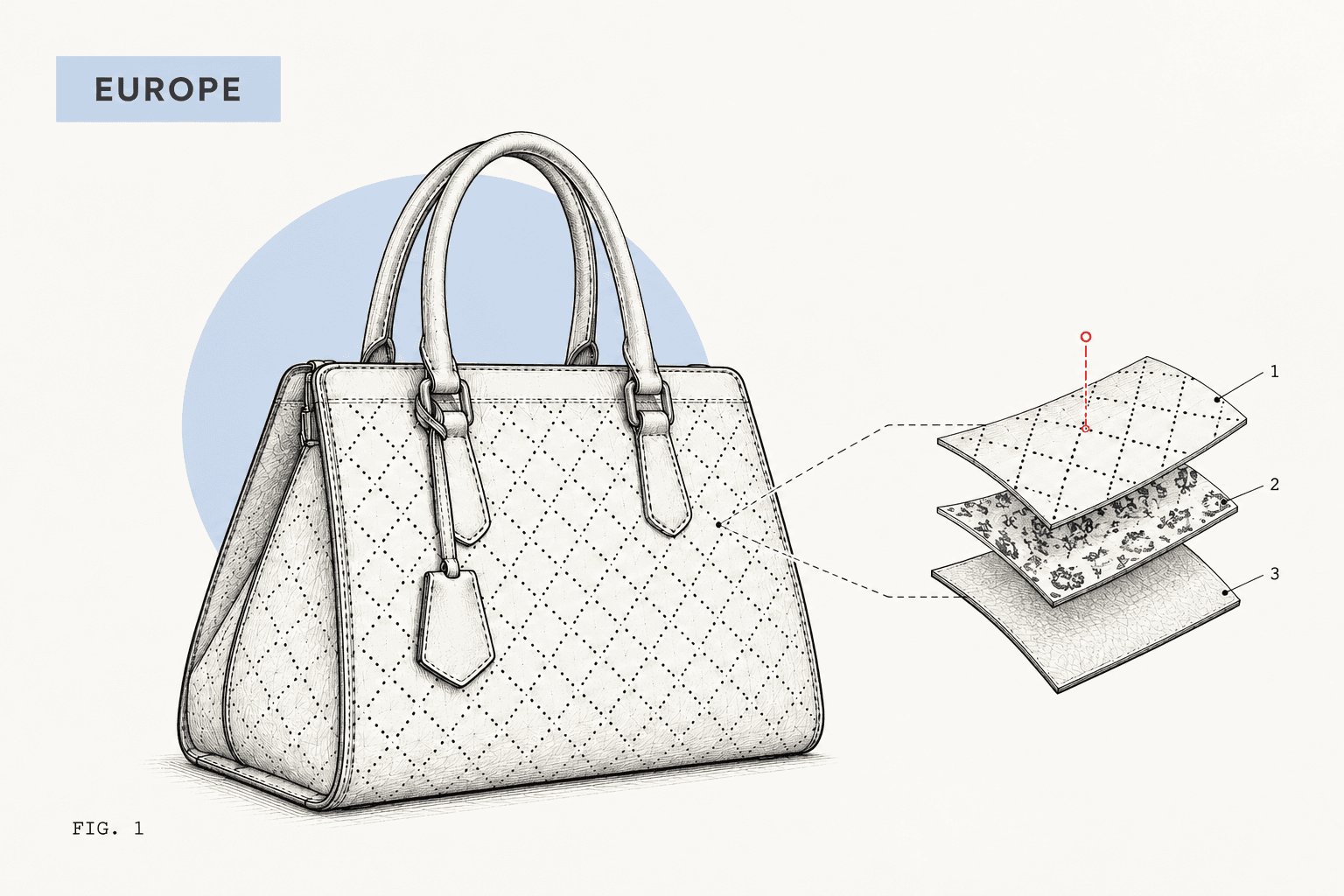
Through laboratory analysis of a second-hand “Flora Wallet” that the Hamburg Local Division had already found to be publicly available before the patent’s 14 April 2017 filing date. A report by Dr. Terrill Clayton, using microscopy, infrared spectroscopy, gas chromatography and mass spectrometry, detected the photoinitiator DETX in the printed sample and concluded that a UV-curable inkjet ink had been used. A Raman spectroscopy report from the Institute for the Chemistry of Organometallic Compounds identified yellow, red, blue and black pigments in the ink dots. The court found that all of these techniques were common general knowledge, citing an engineering textbook by Skoog and Leary that introduces each of them.
The court gave the Clayton report particular weight because of how it was commissioned. Dr. Clayton was asked to determine the printing process and ink chemistry, was given no information about the inks or the process, and was instructed not to read the patent, so his work reflected what the notional skilled person could do. By contrast, a separate analysis by another of Gucci’s experts had been performed with internal Gucci information about the inks and with the specific purpose of finding photoinitiators, which the court said was “not an entirely accurate representation of what the person skilled in the art could do.”
Why did the Hamburg Local Division get a different answer?
Because it construed the claim too narrowly. Claim 1 requires a base coat with “an achromatic colour different from black,” and the Flora Wallet’s base coat is ivory. Hamburg had read the claim to exclude base coats containing a mix of chromatic and achromatic pigments that give an off-white colour. The Court of Appeal held that the description expressly presents an off-white base coat and a combination of pigments as an “aspect of the invention,” that the patent’s own Example 3 replaces part of the white pigment with brown, and that in a method for decorating luxury leather a perfectly flat spectral response “cannot be realized.” Reflectance spectra of the Flora Wallet showed no pronounced peak at a particular wavelength, and Agfa did not dispute that if the accused Gucci products had an achromatic base coat, the Flora products did too.
The court also addressed Gucci’s argument that a claim amendment made during EPO examination had surrendered such embodiments. It left open whether prosecution amendments are relevant to interpretation at all, finding that even if they were, the amendment did not support Gucci’s reading. And it confirmed, citing its 28 August 2026 decision in Hurom v. NUC, that where claims are amended the unamended description remains an explanatory aid.
What survived, and what happens to the infringement case?
Claim 5, which requires polyfunctional monomers or oligomers at 1 to 20 wt% of the ink, survived. It was novel over a Japanese application (JP 2010-185054), and inventive over the Flora products combined with that document, because the court read the concentration range as applying to the combined amount of monomers and oligomers; it was novel over a US application on the separate ground that the US document does not disclose printing on a base coat. Claim 9, which adds heat pressing, also survived in combination with claim 1, as did claims 6, 7 and 8 insofar as they depend from claim 5. Claim 6 on its own was held obvious. Following its 13 July 2026 decision in Fujifilm v. Kodak, the court examined each dependent claim Agfa had defended individually rather than letting them fall with claim 1.
On infringement, Agfa failed to show that the accused Gucci products were made with inks meeting the surviving claim 5 range. The court declined to reverse the burden of proof under Article 55 UPCA, since Agfa had not shown that the claim 5 method yields a new product, and the product claim it relied on, claim 10, was itself anticipated by the Flora Wallet. Agfa must bear the costs of the infringement action and the revocation counterclaims at both instances. The court set the value of the appeal proceedings at EUR 2,500,000. The patent is also in force in Spain and the United Kingdom, which the revocation order does not reach. Agfa was represented by Daan de Lange of Vossius & Brinkhof, Gucci by Dr. Benjamin Schröer of Hogan Lovells Cadwalader.
What practitioners may take from this
The decision suggests that a defendant’s own commercial products, and by the same logic a proprietor’s, can anticipate a method claim in the UPC whenever the claimed steps leave detectable traces, and that the court treated Agfa’s argument that no one would have had reason to test the product as irrelevant. Defendants may consider commissioning analyses that mirror what a skilled person without inside knowledge could do, since the court weighed the blind Clayton report above a targeted one. Proprietors drafting method claims may note that the Flora Wallet disclosed the use of UV curable inks “but not the precise ink formulation,” and that the precise range in claim 5 was what held. The court’s approach to late-filed evidence, admitted on appeal under Rule 222.2 because the filing was justified in part by Agfa’s own conduct, supplemented a report both sides accepted and could be answered, is also set out in the decision. The site’s approach to primary sources is described under standards.
Documents
- Decision of the Court of Appeal, Agfa NV v. Guccio Gucci S.p.A. and others, UPC_CoA_582/2025 et al.
UPC Court of Appeal, Panel 1a, Oct. 21, 2026
- EP 3 388 490 B1, Decorating natural leather
Google Patents

Staff · Patent decisions, prosecution practice and AI in patent work
Stories under this byline are reported from the primary documents: Federal Circuit opinions, PTAB decisions, USPTO notices and European rulings.
Read more from EditorSpotted an error? Read our editorial standards and corrections policy, or send us a tip.