On 1 October 2026 the U.S. Court of Appeals for the Federal Circuit held in Satius Holding, LLC v. Samsung Electronics Co., No. 2025-1446, that patent claims reciting a scientific impossibility are not indefinite for that reason alone, and then affirmed the judgment of invalidity on a ground the district court never reached: lack of enablement. Chief Judge Moore wrote for a panel that included Judges Lourie and Hughes. The decision is precedential.
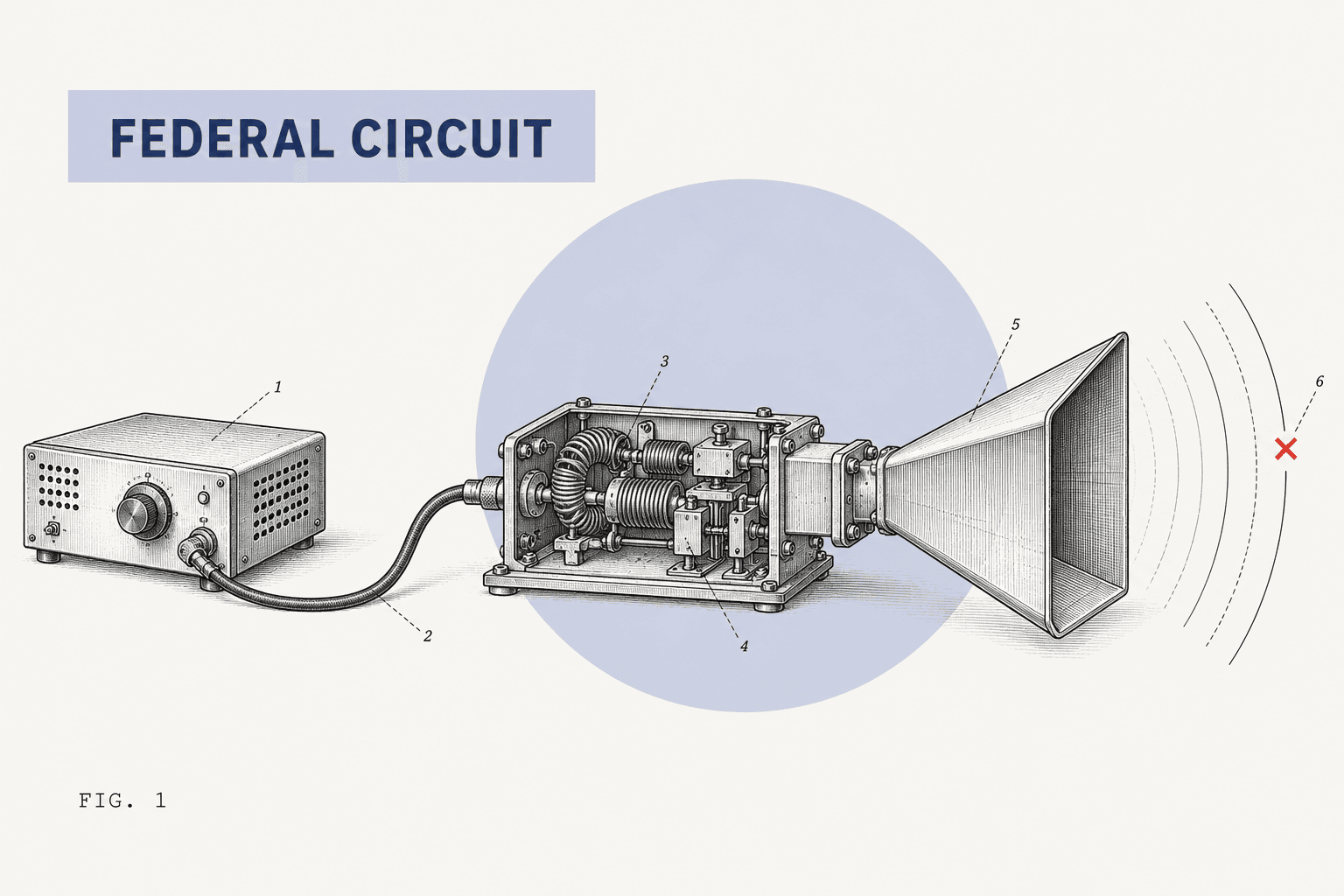
The case concerns U.S. Patent No. 6,711,385, a “Coupler for wireless communications” owned by Satius. Claim 1 recites “[a] communications apparatus for transmitting electric or electromagnetic signals over air” with a coupler that matches a transmitter’s output impedance to “the characteristic impedance of the air.” The parties agreed that transmitting a signal over air in electric form is impossible. The U.S. District Court for the District of Delaware had held claims 1, 11 and 18 indefinite on that basis and entered final judgment for Samsung. More decisions from the court are on the Federal Circuit hub.
Why is an impossible claim not indefinite?
Because definiteness asks whether the claim’s scope is clear, not whether what it claims can work. The panel wrote: “Indefiniteness is not the same as impossibility.” It added that “there is no per se rule that a claim covering inoperable embodiments is necessarily indefinite.” It relied on Miles Laboratories v. Shandon (1993), which said an invention’s operability “may say nothing about a skilled artisan’s understanding of the bounds of the claim,” and on Exxon Research v. United States (2001), abrogated on other grounds by Nautilus, which described inoperability as “an issue of enablement, and not indefiniteness.”
The court first construed “transmitting electric . . . signals over air” to mean transmitting signals over air in electric form. Satius had argued the phrase referred to an electric signal that is converted into an electromagnetic one before it leaves the device. The panel disagreed: transmitting signals over the air is not the same as transmitting them to the air, and reading in a conversion step would require rewriting the claim. Quoting Chef America v. Lamb-Weston (2004), the court said it “may not redraft claims . . . to make them operable or to sustain their validity.”
The panel distinguished Synchronoss v. Dropbox (2021), where claims that required an impossibility were held indefinite. There, the court explained, the claims were “nonsensical” when read against the specification, so a skilled artisan would understand that they did not set forth what the inventor regarded as the invention. In Satius, both the claims and the written description contain the impossible language, and Samsung itself had argued that claim 1 “unmistakably” covers the impossibility. A claim that informs skilled artisans of its scope with reasonable certainty satisfies § 112(b), the court held, even when part of that scope cannot be built.
A footnote addresses the district court’s reliance on Samsung’s expert, Dr. Wells, who testified that transmitting non-electromagnetic signals over air “does not have any meaning” to a skilled artisan. The panel called this “conclusory extrinsic evidence” that contradicted Samsung’s own position that the term does have a meaning, and noted the district court quoted it only to support the incorrect statement that a claim is indefinite because one of its permutations is impossible.
Why did the claims fail enablement instead?
Because the claims expressly add an embodiment that no one can make or use. The opinion rests on the Supreme Court’s statement in Amgen Inc. v. Sanofi, 598 U.S. 594 (2023), that “the specification must enable the full scope of the invention as defined by its claims.” That standard, the panel wrote, “cannot possibly be met when, as here, the claims include an express limitation that adds inoperable (and thus non-enabled) alternative embodiments to the scope of the invention.”
The court cited Liebel-Flarsheim v. Medrad (2007), where a claim covering injector systems with and without a pressure jacket required “reasonable enablement of the scope of the range,” and EMI Group v. Cypress Semiconductor (2001), quoting Process Control v. HydReclaim (1999): when “an impossible limitation, such as a nonsensical method of operation, is clearly embodied within the claim, the claimed invention must be held invalid.” Returning to Amgen’s line that “[t]he more one claims, the more one must enable,” the panel concluded that these claims “fall woefully short of this burden.” An explainer on what full-scope enablement means for claim drafting sets out the test in more detail.
How did the court reach an issue the trial court called waived?
By exercising the discretion appellate courts have to decide a pure question of law whose resolution is “beyond any doubt.” The district court had written that it “struggle[d] to see how the full scope of claim 1 could be enabled” but treated enablement as waived and observed that claim construction “is not typically the right time” to address it. The Federal Circuit saw “no bar” to taking the issue up, citing Singleton v. Wulff (1976) and factors drawn from Icon Health & Fitness v. Strava (2017), among them whether the issue is a pure question of law, whether its resolution is beyond doubt, whether it has been fully briefed, whether a party would be prejudiced and whether remand would serve any purpose.
The panel concluded it was appropriate to reach the issue, for three reasons. Both sides had raised and briefed enablement on appeal, enablement is reviewed without deference as a question of law, there was no factual dispute about the impossibility, and “it would serve no purpose to remand this case only for the district court to reach the same conclusion.” The court affirmed the final judgment of invalidity of claims 1, 11 and 18 and awarded costs to Samsung.
What should practitioners do differently?
For litigators, the decision suggests that inoperable claim language is a § 112(a) problem, and that pleading it only as indefiniteness risks winning below and losing on appeal. Here the result was the same because the Federal Circuit was willing to reach enablement itself, but it did so on a narrow record: an undisputed impossibility, briefing by both sides and a question of law. Where operability is contested on the facts, a defendant that has not developed the enablement record may not be rescued in the same way.
For drafters, the opinion is a reminder that an “A or B” alternative written into a claim is a promise to enable both A and B. Satius’s preamble added “electric or electromagnetic,” and the first alternative was unenabled by definition. Practitioners may consider auditing disjunctive lists, preambles and “configured to” clauses for alternatives that the specification does not support, since under Amgen the claim, not the preferred embodiment, measures what must be enabled. The decision also shows that a claim can survive one § 112 attack while remaining exposed to another: the court found the claim clear precisely because its impossible scope was unmistakable.
Background and what happens next
Satius sued Samsung Electronics Co. and Samsung Electronics America in 2018. The district court stayed the case for reexamination at the U.S. Patent and Trademark Office, which, according to the opinion, rejected independent claim 1 and upheld dependent claims 11 and 18. After the stay lifted, Magistrate Judge Christopher J. Burke issued a claim-construction decision on 12 December 2024 holding all three claims indefinite, and entered final judgment for Samsung. Daniel Noah Lerman of Herbert Smith Freehills Kramer argued for Satius; Richard L. Rainey of Covington & Burling argued for Samsung.
The 14-day period for a petition for rehearing under Federal Rule of Appellate Procedure 40 ran from the 1 October 2026 judgment and closed on 15 October 2026; the docket was not checked for a petition. On the same day, in a separate nonprecedential opinion, In re Satius Holding, Inc., No. 2025-1444, the same panel dismissed as moot Satius’s appeal from the Board’s obviousness rejection of claim 1 in the ex parte reexamination, No. 90/014,826, because claim 1 had been held invalid in the Samsung appeal. Related coverage of district-court outcomes is on the Litigation hub; the site’s sourcing rules are described under standards.
Documents
- Opinion, Satius Holding, LLC v. Samsung Electronics Co., No. 2025-1446
Fed. Cir. Oct. 1, 2026, precedential
- Opinion, In re Satius Holding, Inc., No. 2025-1444
Fed. Cir. Oct. 1, 2026, nonprecedential; reexamination appeal dismissed as moot
- Amgen Inc. v. Sanofi, 598 U.S. 594 (2023)
Supreme Court, May 18, 2023
- 35 U.S.C. § 112
Enablement, § 112(a); definiteness, § 112(b)

Staff · Patent decisions, prosecution practice and AI in patent work
Stories under this byline are reported from the primary documents: Federal Circuit opinions, PTAB decisions, USPTO notices and European rulings.
Read more from EditorSpotted an error? Read our editorial standards and corrections policy, or send us a tip.